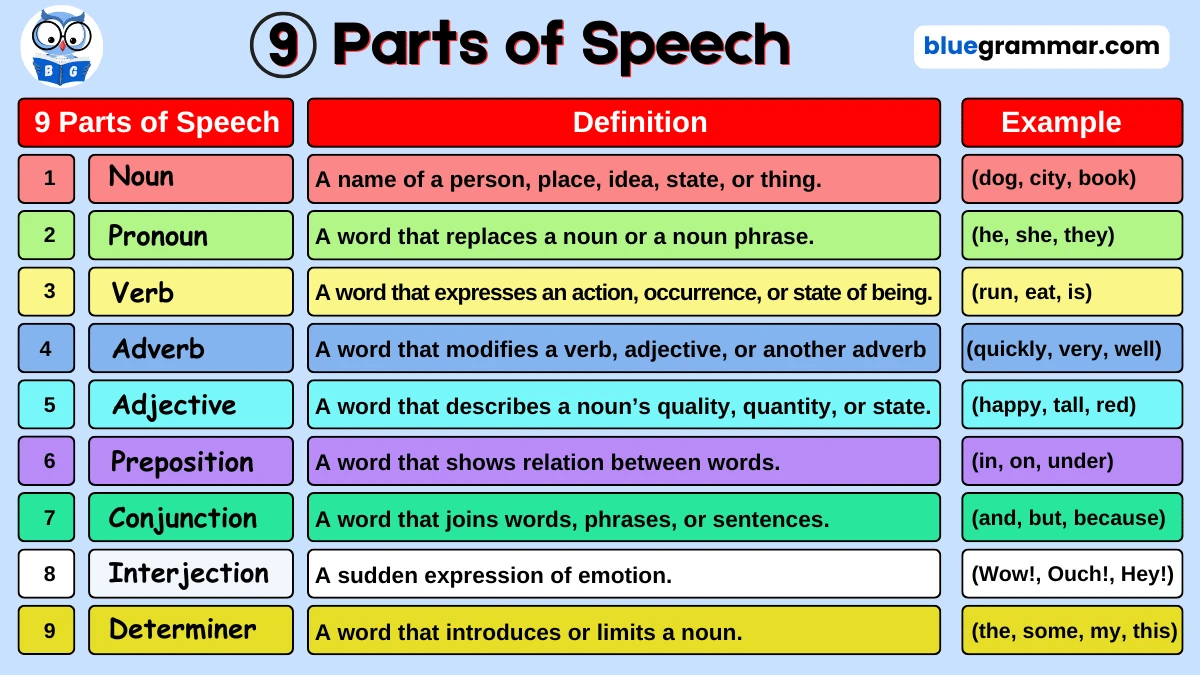
9 parts of speech chart with definitions and examples, including noun, pronoun, verb, adverb, adjective, preposition, conjunction, interjection, and determiner. English grammar infographic from BlueGrammar.com.
Every English sentence is built from a small group of word classes known as the parts of speech. Each class has a specific grammatical function. Some words name people or things, others express actions, describe qualities, show relationships, or connect ideas. Understanding how these categories work makes reading, writing, and speaking English much easier.
Modern English grammar generally recognizes nine parts of speech:
The Shift in Grammar: Eight vs. Nine Parts of Speech
In English grammar, there is some debate about how many parts of speech there are—eight or nine. Traditionally, many grammar resources list eight parts of speech, which include noun, pronoun, verb, adverb, adjective, preposition, conjunction, and interjection. However, modern linguistic studies recognize nine parts of speech by treating determiners as a separate category.
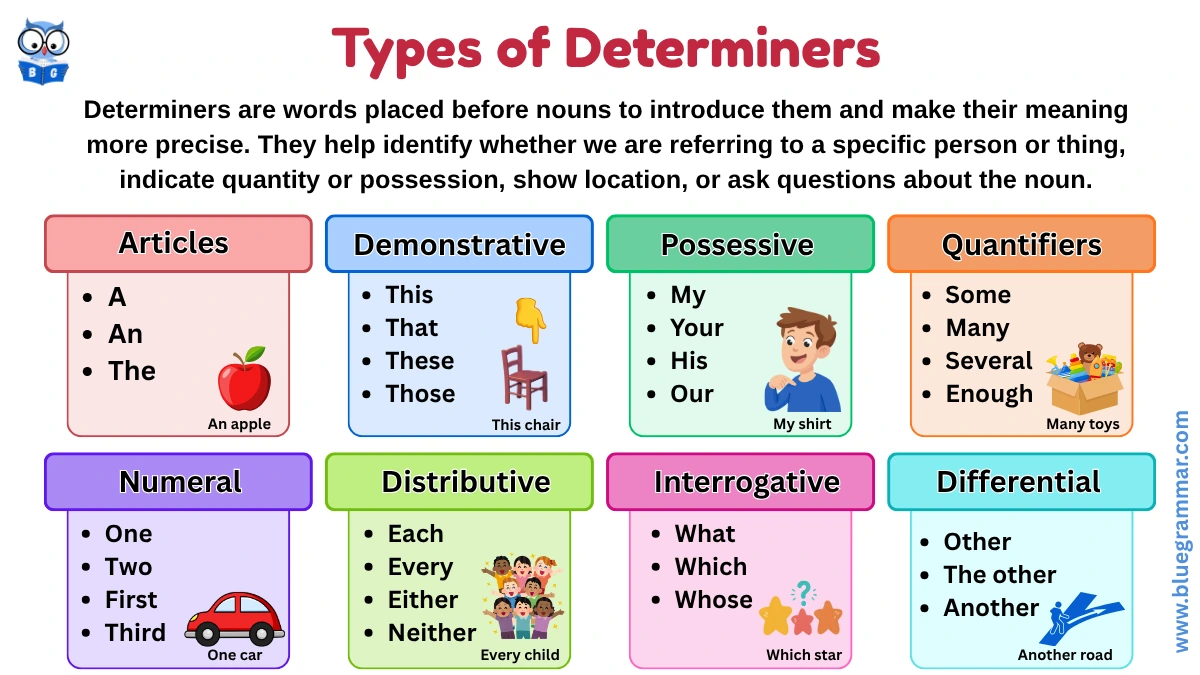
Determiners include words like the, a, some, and this, and they are used to introduce and specify nouns. In older grammar approaches, determiners were often grouped with adjectives since both words provide more information about nouns.
However, in modern grammar, determiners are considered distinct because they serve a different function—they determine or clarify the noun rather than describe its qualities.
Another point of confusion arises in some places where articles (such as the and a) are seen as separate parts of speech. This categorization sometimes leads to debates about whether determiners and articles should be treated as one category or two.
The distinction between different grammar systems shows how language evolves, and the classification of parts of speech depends on the approach a person follows.
The Importance of Learning Parts of Speech
Learning the parts of speech is important because they help us understand how words work together in a sentence. By knowing the function of each part of speech, we can use words correctly and make our communication clearer. Each part of speech helps to form the structure of a sentence.
Without these parts of speech, sentences would not make sense. For example, a sentence like “She quickly runs” is easy to understand because the words follow the rules of grammar.
The Nine Parts of Speech
Here’s a simple explanation of each part of speech with examples:
Noun
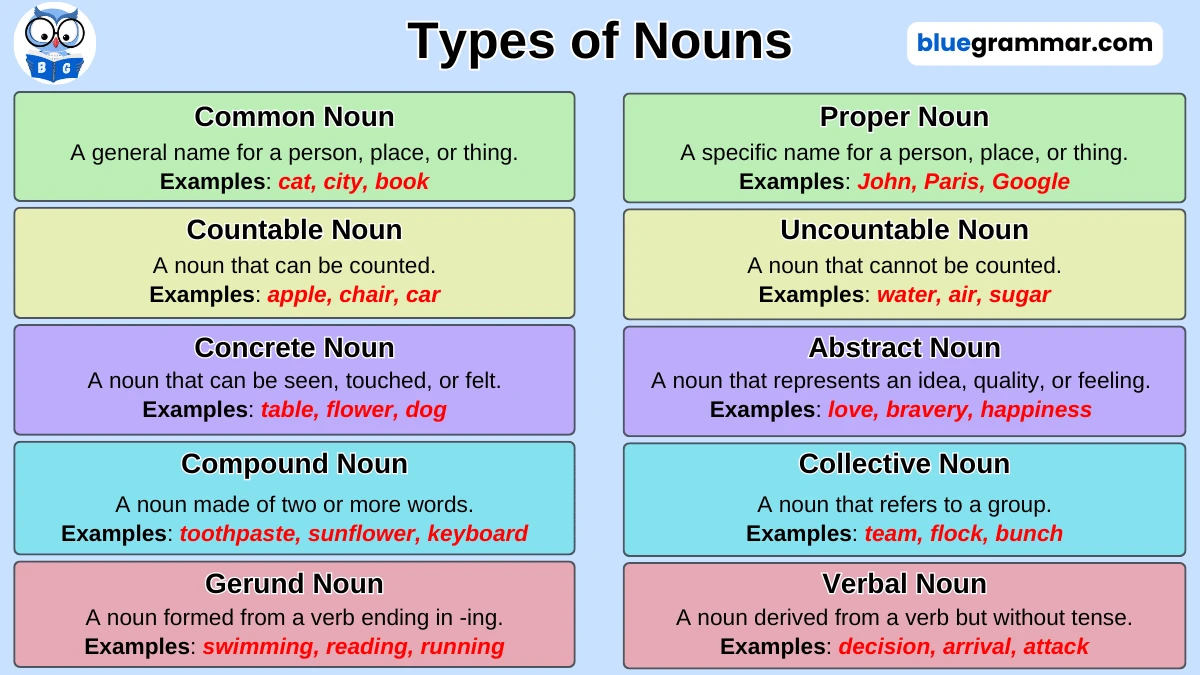
A noun is a word that names a person, place, thing, or idea. It can act as a subject, object, or complement in a sentence.
Example:
- Sara reads books. (Sara is a noun as the subject, books is a noun as the object.)
- The cat sleeps. (Cat is a noun as the subject.)
- Honesty is important. (Honesty is a noun as the subject.)
Pronoun
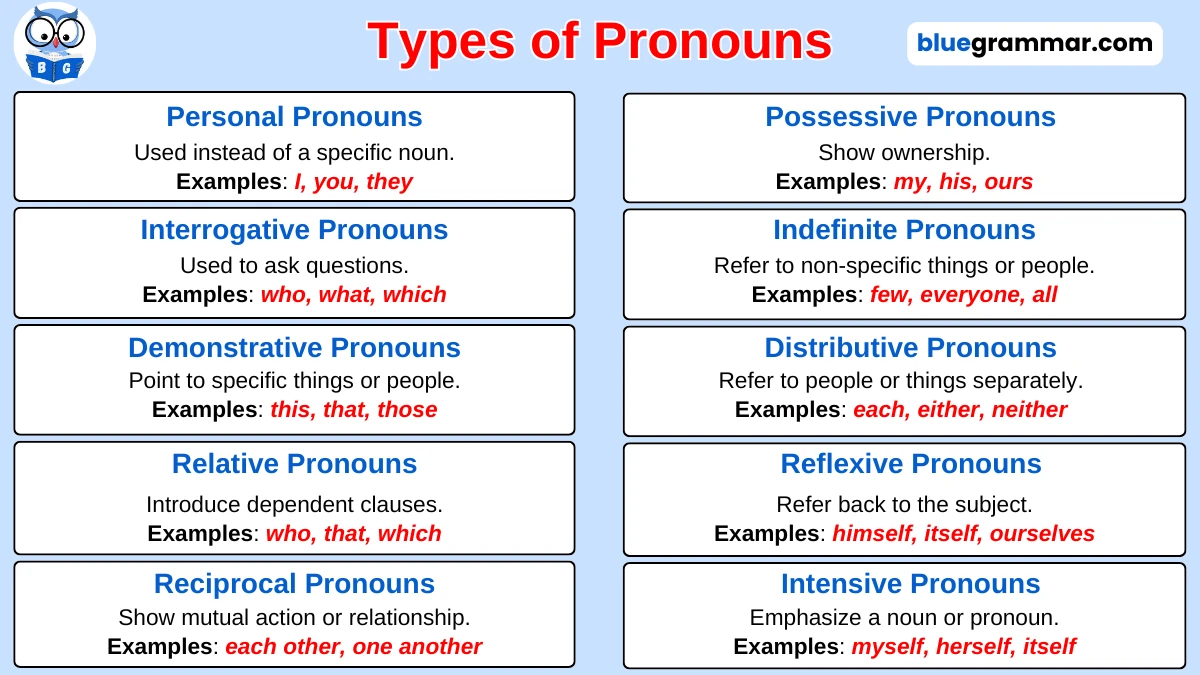
A pronoun is a word used in place of a noun to avoid repetitive phrasing. Common examples include he, she, it, they, we, and you.
Example:
- John called his mother because he needed guidance. (He and his replace John.)
- The students finished their project on time. (Their refers back to students.)
- Everyone enjoyed the event. (Everyone acts as an indefinite pronoun.)
Verb
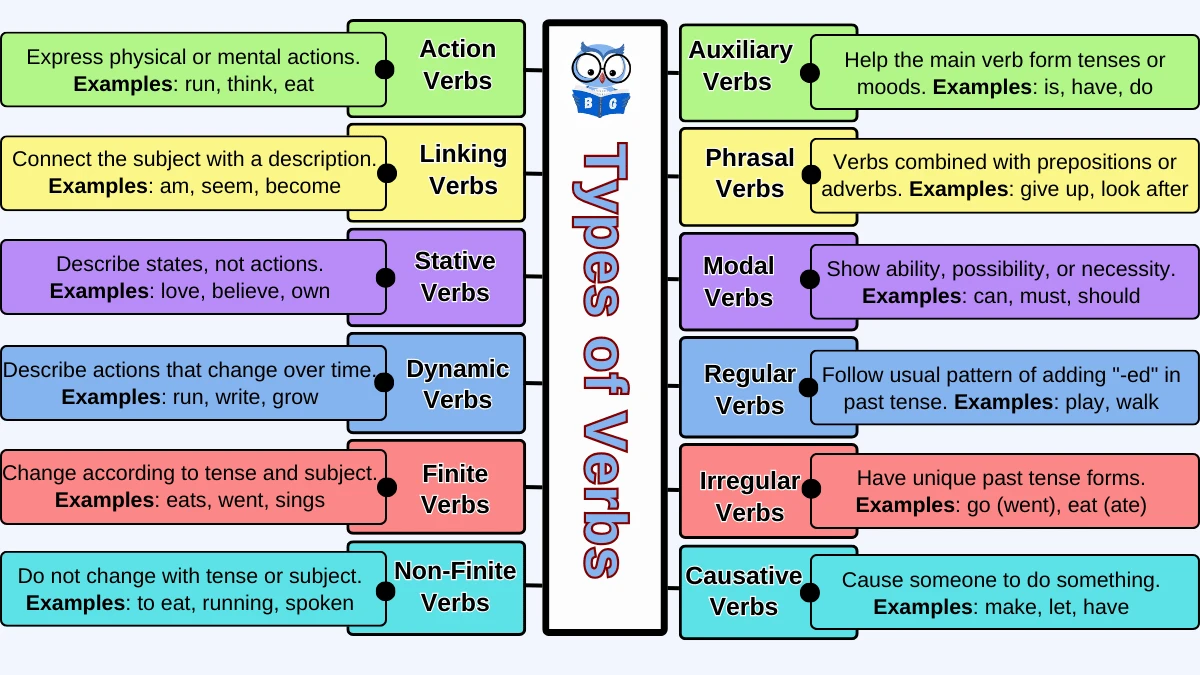
A verb expresses an action, a state of being, or an occurrence. Every complete sentence must contain at least one verb.
Example:
- The bird flew across the sky. (Flew expresses a physical action.)
- She seems confident about the test. (Seems links the subject to a state of being.)
- They will build a new bridge next year. (Will build shows future action.)
Adjective
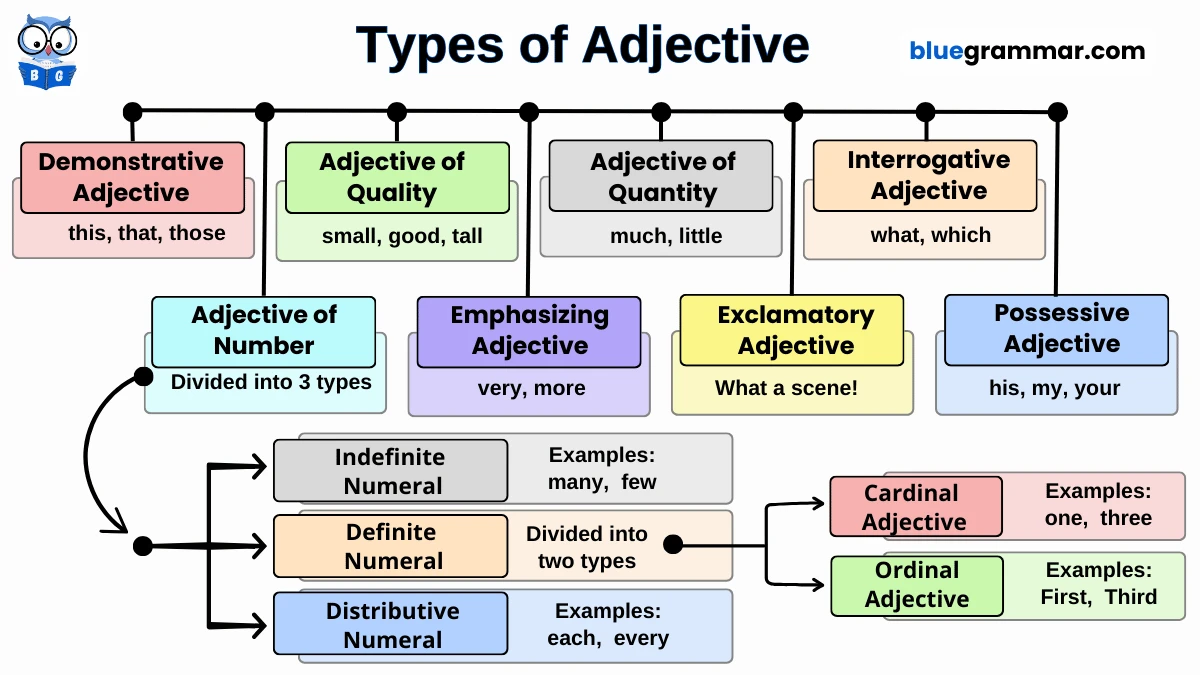
An adjective modifies or describes a noun or a pronoun by giving qualities, details, or quantities.
Example:
- The ancient castle stood on top of a steep hill. (Ancient and steep modify castle and hill.)
- She wore a bright red coat. (Bright and red describe the coat.)
- Several students answered the difficult question correctly. (Several and difficult modify students and question.)
Adverb
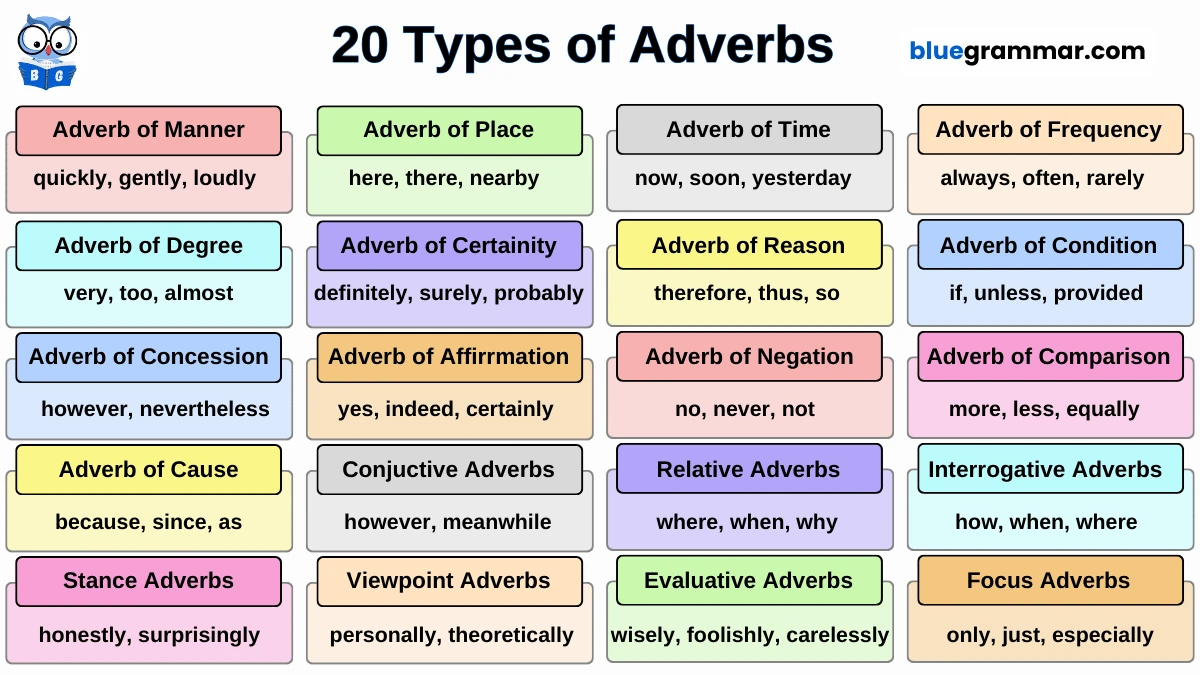
An adverb modifies a verb, an adjective, or another adverb. It usually answers questions such as how, when, where, or to what extent.
Example:
- He walked quietly through the hallway. (Quietly explains how he walked.)
- The weather was extraordinarily cold yesterday. (Extraordinarily modifies the adjective cold.)
- She arrived early for the meeting. (Early tells when she arrived.)
Preposition
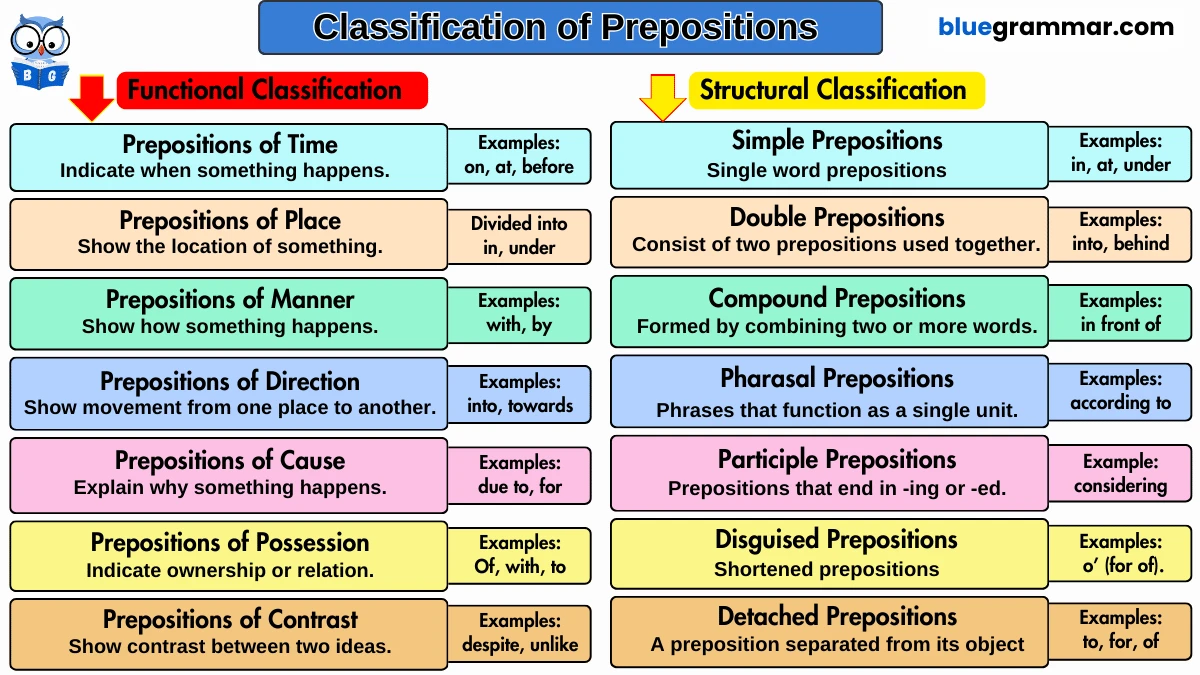
A preposition shows the relationship between a noun or pronoun and other words in a sentence regarding location, time, direction, or spatial arrangement.
Example:
- The cat slept under the comfortable couch. (Under shows spatial position.)
- We will meet after the lecture finishes. (After indicates time sequence.)
- She walked into the library quietly. (Into demonstrates direction.)
Conjunction
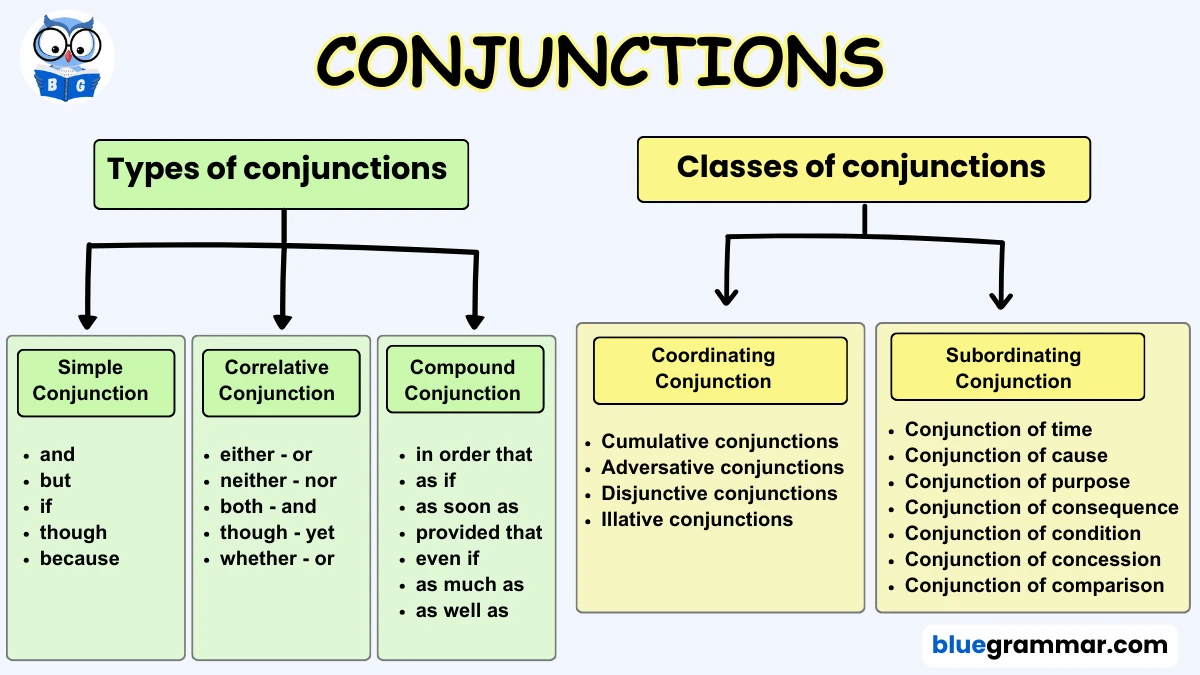
A conjunction links words, phrases, or clauses together within a sentence. Common examples include and, but, because, or, and although.
Example:
- She wanted to study abroad, but she missed the deadline. (But connects two independent clauses.)
- He brought bread and cheese for the trip. (And connects two nouns.)
- We stayed inside because it began to rain heavily. (Because introduces a reason.)
Interjection
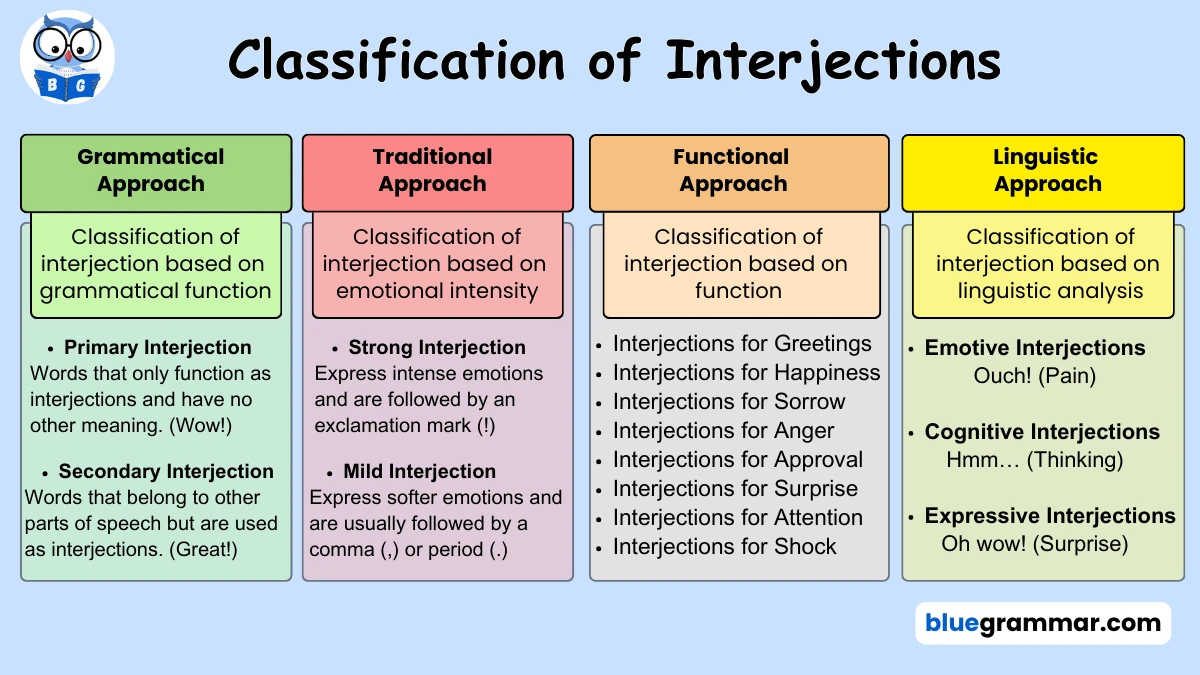
An interjection is a word or short phrase that expresses sudden emotion or reaction. It usually stands apart from the grammatical structure of the sentence.
Example:
- Wow! That performance was outstanding. (Wow shows surprise.)
- Ouch! The tea is extremely hot. (Ouch communicates sudden discomfort.)
- Well, I suppose we can try again tomorrow. (Well acts as a mild transition.)
Determiner
A determiner introduces a noun and provides context such as quantity, ownership, or specificity. Categories include articles, demonstratives, possessives, and quantifiers.
Example:
- Those apples on the counter are fresh. (Those points out specific nouns.)
- My brother borrowed his friend's vehicle. (My and his show ownership.)
- Each student received a certificate. (Each specifies individual members of a group.)