
Have you ever wondered whether phrases like “to carefully read” or “to fully understand” are grammatically correct? These expressions are examples of split infinitives.
Consider this sentence:
“Students should try to carefully review the instructions before beginning the test.”
Here, the adverb carefully appears between to and the verb review, creating a split infinitive.
For many years, split infinitives were considered grammatical mistakes. However, modern English grammar accepts them in many situations, especially when they improve clarity and make sentences sound more natural.
In this article, you will learn what split infinitives are, how they work, when to avoid them, and when they are perfectly acceptable.
What Is an Infinitive?
An infinitive is the base form of a verb, typically introduced by to in English: to write, to think, to understand, and to go. This two-part form—to plus the verb—is called the full infinitive or the to-infinitive.
Infinitives can function as nouns, adjectives, or adverbs in a sentence.
Examples of Infinitives
- Noun: To learn English takes practice.
- Adjective: She has a report to complete.
- Adverb: He went to the library to study.
In each sentence, the highlighted infinitive performs a different grammatical function.
What Is a Split Infinitive?
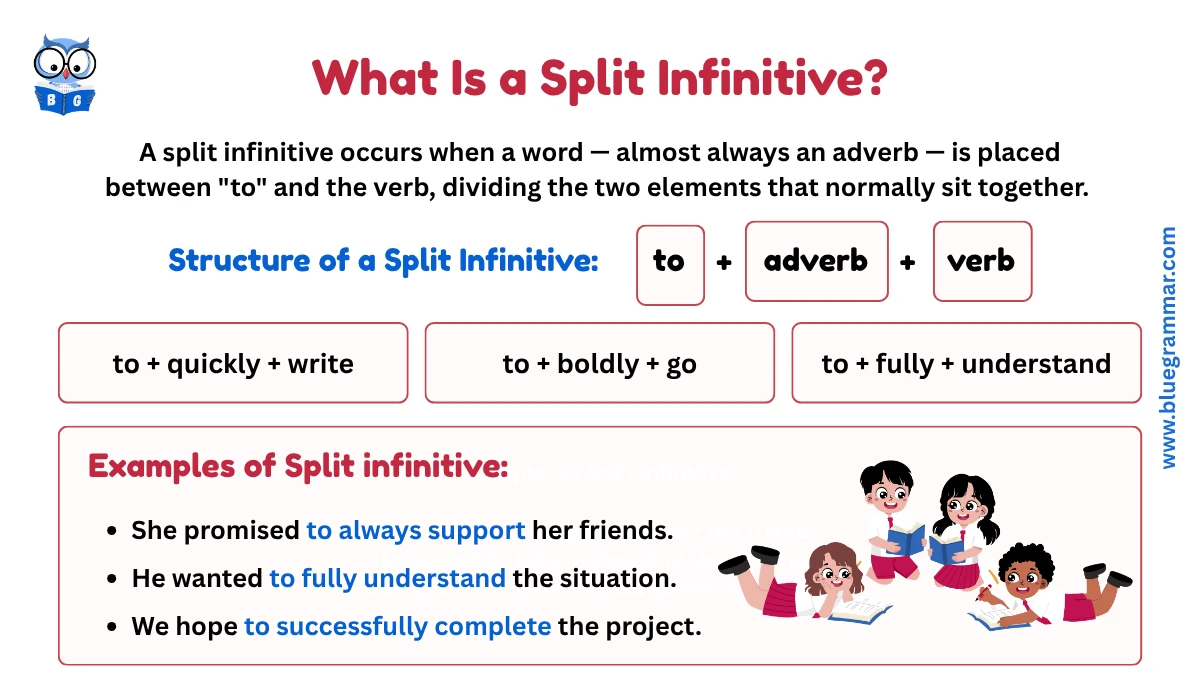
A split infinitive occurs when a word — almost always an adverb — is placed between “to” and the verb, dividing the two elements that normally sit together:
Structure of a Split Infinitive: to + adverb + verb
Examples
- Standard Structure: to go boldly / to understand fully / to write quickly
- Split Infinitive: to boldly go / to fully understand / to quickly write
In each example, the adverb splits the infinitive phrase.
Correct and Natural Usage of Split Infinitives
- She promised to always support her friends.
- He wanted to fully understand the situation.
- We hope to successfully complete the project.
When Splitting the Infinitive Is the Right Choice
There is not one single reason to split an infinitive — there are several distinct situations where the split version is clearly the better choice. Understanding these cases will help you make confident, informed decisions as a writer.
Situation 1: When Moving the Adverb Changes the Meaning
This is the most important case. Sometimes an adverb placed between “to” and the verb has a different meaning from the same adverb placed anywhere else in the sentence. In these cases, the split infinitive is not just acceptable — it is necessary for accurate meaning.
- Split infinitive: She was asked to regularly check her blood pressure.
- Without split — different meaning: She was asked regularly to check her blood pressure.
In the first sentence, “regularly” tells us how often to check. In the second, it tells us how often she was asked. The two sentences are not interchangeable. Only the split infinitive version delivers the intended meaning accurately.
Situation 2: When Moving the Adverb Creates Ambiguity
Sometimes, moving the adverb out of the split position creates genuine ambiguity about what the adverb is modifying. In those cases, the split infinitive is the clearer choice.
Ambiguous Adverb: ‘She liked to read thoughtfully translated books.’
Does “thoughtfully” describe how she reads, or how the books were translated? The sentence cannot tell us. The MLA Style Center uses this exact example to demonstrate that a split infinitive is the correct fix:
Clear — split: She liked to thoughtfully read translated books.
Situation 3: When the Adverb Simply Cannot Move
Some phrases are grammatically stranded. There is no clean alternative position for the adverb, and attempting to move it produces something that barely qualifies as English.
| Type | Example |
|---|---|
| Split (natural) | The population is expected to more than double by 2040. |
| Alternative (impossible) | “The population is expected more than to double by 2040.” |
“More than” cannot be separated from what it modifies. It must precede “double.” Avoiding the split infinitive here is simply not possible without rewriting the sentence entirely.
When Should You Avoid Split Infinitives?
Just because split infinitives are grammatically permissible does not mean they are always the best choice. There are clear situations where keeping the infinitive intact produces better writing.
1. When the Adverb Fits Naturally Elsewhere
If an adverb can be placed after the verb — or elsewhere in the sentence — without any loss of meaning, naturalness, or emphasis, keeping the infinitive unsplit is generally preferable. It avoids any residual reader irritation.
- Split (not necessary): We need to closely monitor the situation.
- Better unsplit: We need to monitor the situation closely.
2. When Too Many Words Split the Infinitive
There is a difference between a one-word adverb splitting an infinitive and a long phrase doing so. The longer the split, the harder the sentence becomes to read. When the split becomes wide, restructuring is usually better.
- Wide split — avoid: He planned to carefully, thoroughly, and without any visible hesitation address the panel.
- Better restructured: He planned to address the panel carefully, thoroughly, and without any visible hesitation.
3. In Formal Academic or Legal Writing
Even though split infinitives are grammatically sound, some academic journals, law firms, and publishers still have house styles that advise against them. If you are submitting to a publication with a specific style guide, or writing for an editor you know objects to split infinitives, it is professional and practical to respect that preference — as long as doing so does not obscure your meaning.
The practical rule:
Split when it improves clarity, precision, or naturalness. Don’t split merely out of habit. Don’t avoid splitting when doing so would make the sentence worse.
Why Were Split Infinitives Considered Incorrect?
In the nineteenth century, some grammarians argued that infinitives should never be split because Latin infinitives consist of a single word and cannot be divided.
For example, in Latin: amare (to love)
Since English developed differently from Latin, many modern language experts no longer support this rule. Today, major style guides generally allow split infinitives when they improve clarity and readability.
Tips for Using Split Infinitives
- 1. Prioritize Clarity: Use a split infinitive if it makes the sentence easier to understand.
- 2. Avoid Unnecessary Splitting: Do not split infinitives merely out of habit.
- 3. Consider Your Audience: Formal institutions may have specific preferences regarding style.
- 4. Read the Sentence Aloud: Choose the version that sounds the most natural and effective.
Quick Summary
- A split infinitive occurs when an adverb (or other word) is placed between “to” and the verb: “to boldly go.”
- The rule against splitting infinitives was invented in the 19th century — not by Robert Lowth — and was based on a false analogy with Latin.
- All major modern authorities — Quirk et al., Cambridge Grammar, Strunk & White, Merriam-Webster, Oxford — accept split infinitives as grammatically correct.
- Split when it changes the meaning, avoids ambiguity, has no viable alternative, or sounds significantly more natural.
- Avoid splitting when the adverb fits naturally elsewhere, the split is very wide, or a specific style guide prohibits it.
- The test is always meaning and clarity, not a rule inherited from a language English is not.
Frequently Asked Questions
What is a split infinitive?
A split infinitive occurs when a word, usually an adverb, is placed between to and the base form of a verb.
Are split infinitives grammatically correct?
Yes. Modern English grammar generally considers split infinitives acceptable, especially when they improve clarity.
Why were split infinitives discouraged?
Traditional grammarians modeled English grammar after Latin, where infinitives cannot be split because they are single words.
Should I avoid split infinitives in formal writing?
It depends on the style guide you follow. If the sentence remains clear without splitting the infinitive, either form may be used.
Final Thoughts
Split infinitives show how grammar rules can change over time. Although they were once widely criticized, modern grammar experts generally accept them when they improve clarity, precision, or naturalness.
The most important question is not whether an infinitive has been split. Instead, ask whether the sentence communicates your meaning clearly and effectively. If placing an adverb between to and the verb makes the sentence more natural or avoids ambiguity, a split infinitive is often the best choice.
Language exists to communicate ideas. When a grammar rule helps communication, follow it. When it makes a sentence less clear, it is worth considering a more natural alternative. The goal of good writing is not to follow rules blindly but to express your meaning as clearly as possible.
References & Further Reading
- Quirk, R., Greenbaum, S., Leech, G., & Svartvik, J. (1985). A Comprehensive Grammar of the English Language. London: Longman.
- Huddleston, R., & Pullum, G. K. (2002). The Cambridge Grammar of the English Language. Cambridge: Cambridge University Press.
- Perales-Escudero, M. D. (2010). To split or to not split: The split infinitive past and present. American Speech, 86(1). SAGE Publications.
- Merriam-Webster. ‘To Boldly Split Infinitives.’
- MLA Style Center. ‘Is it OK to split infinitives?’