
The ellipsis (…) is a punctuation mark made up of three dots. It is used to show that something has been left out, a pause in speech, or an unfinished thought. While it looks simple, the ellipsis has several important uses in both formal and informal writing.
In this guide, you will learn how to use the ellipsis correctly, with clear explanations, examples, and common mistakes to avoid.
What Is an Ellipsis (…) ?
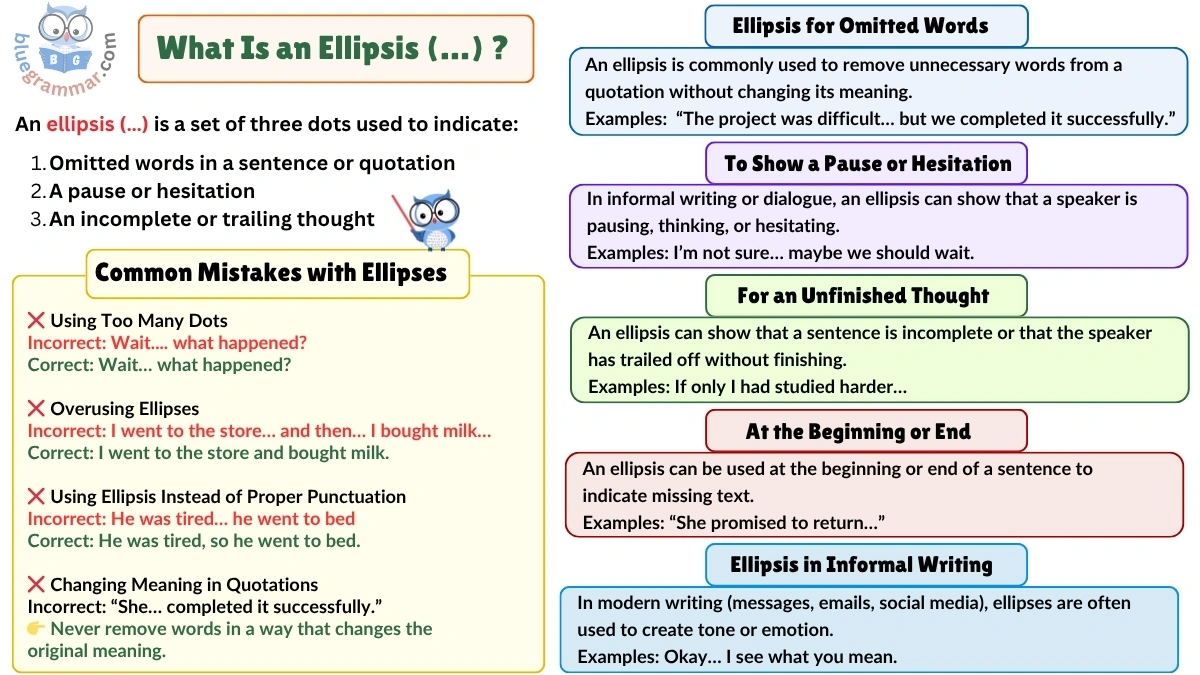
An ellipsis (…) is a set of three dots used to indicate:
- Omitted words in a sentence or quotation
- A pause or hesitation
- An incomplete or trailing thought
It helps writers shorten text or create a specific tone in writing.
1. Ellipsis for Omitted Words (In Quotations)
An ellipsis is commonly used to remove unnecessary words from a quotation without changing its meaning. This is especially useful in academic and formal writing.
- Original: “The project was difficult, but we completed it successfully on time.”
- Shortened: “The project was difficult… but we completed it successfully.”
Explanation: When using an ellipsis in quotations, make sure the original meaning of the sentence is not changed. It should only remove extra or less important information.
2. Ellipsis to Show a Pause or Hesitation
In informal writing or dialogue, an ellipsis can show that a speaker is pausing, thinking, or hesitating.
- Example: “I’m not sure… maybe we should wait.”
- Example: “Well… I don’t know what to say.”
Explanation: The ellipsis helps create a natural speaking rhythm. It makes the sentence feel more realistic and expressive. This use is common in conversations, stories, and creative writing.
3. Ellipsis for an Unfinished Thought
An ellipsis can show that a sentence is incomplete or that the speaker has trailed off without finishing.
- Example: “If only I had studied harder…”
- Example: “I thought I could trust him, but…”
Explanation: This use is often found in storytelling, emotional writing, or informal communication where the full thought is intentionally left unsaid for the reader to understand.
4. Ellipsis at the Beginning or End of a Sentence
An ellipsis can be used at the beginning or end of a sentence to indicate missing text.
- Example: “…and that is how the story ended.”
- Example: “She promised to return…”
Explanation: This is often used in quotations or excerpts, especially in academic writing, to show that the full sentence is longer than what is shown.
5. Ellipsis in Informal Writing (Tone and Style)
In modern writing (messages, emails, social media), ellipses are often used to create tone or emotion.
- Example: “Okay… I see what you mean.”
- Example: “So… what happens next?”
Explanation: It can express doubt, suspense, or softness. While useful, overusing ellipses in formal writing can make your text look unclear or unprofessional.
Spacing Rules for Ellipses
There are two common styles:
- No Spaces (Modern Style):
Example: Wait… what happened? - With Spaces (Formal/Academic Style):
Example: Wait … what happened?
Be consistent with the style you choose.
Common Mistakes with Ellipses
- Using Too Many Dots
❌ Wait…. what happened?
✔ Wait… what happened?
Note: Always use three dots, not four or more. - Overusing Ellipses
❌ I went to the store… and then… I bought milk… and came back…
✔ I went to the store and bought milk.
Note: Too many ellipses make writing unclear and weak. - Using Ellipsis Instead of Proper Punctuation
❌ He was tired… he went to bed
✔ He was tired, so he went to bed.
Note: Use ellipses only when needed, not as a replacement for commas or periods. - Changing Meaning in Quotations
❌ “She… completed it successfully.” (misleading removal)
Note: Never remove words in a way that changes the original meaning.
Quick Summary of Ellipsis Rules
| Rule / Purpose | Correct Usage |
|---|---|
| Omitted Words | Use (…) to shorten quotes without changing the meaning. |
| Pauses & Hesitation | Use to mimic natural pauses or dialogue hesitation. |
| Unfinished Thoughts | Use when trailing off or leaving a thought open. |
| Dot Count | Always exactly three dots (…). |
| Formal Writing | Use sparingly to keep text professional and clear. |
Remember: An ellipsis always consists of exactly three dots (…). Avoid four or more dots, and use them thoughtfully to preserve readability.
Conclusion
The ellipsis (…) is a powerful punctuation mark that helps create tone, shorten text, and express incomplete ideas. When used correctly, it adds clarity and style to your writing. However, overusing or misusing it can confuse readers.
By understanding its rules and practicing with examples, you can use ellipses effectively in both formal and informal English.