
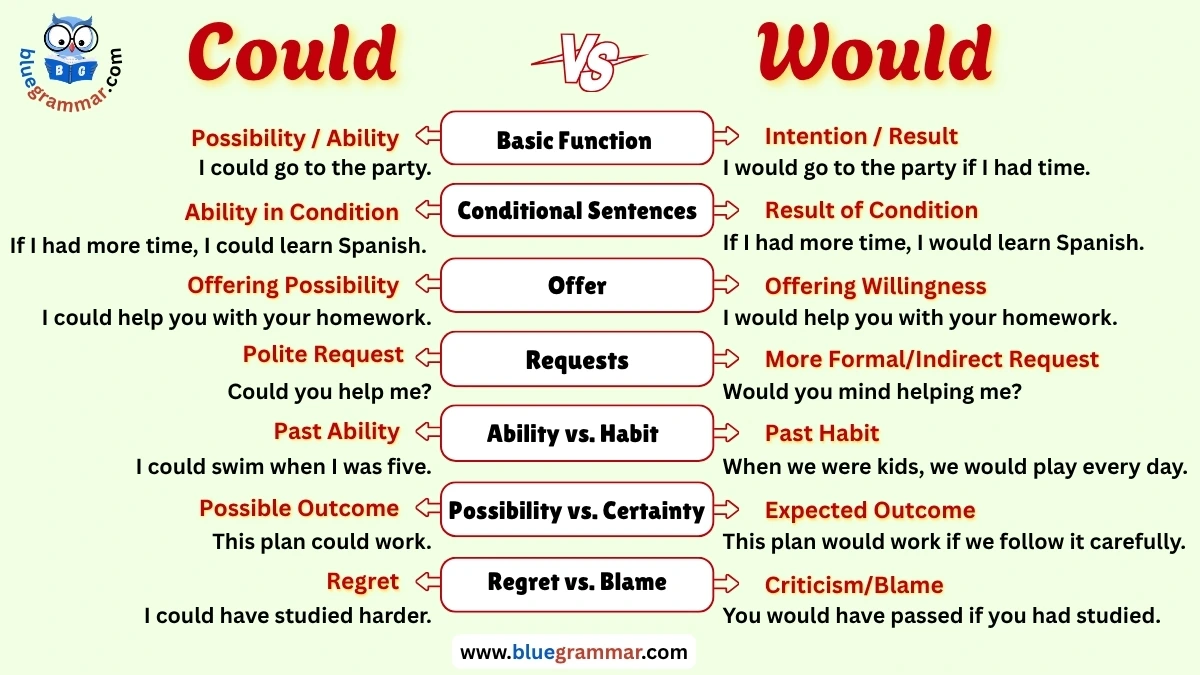
Understanding could vs. would is important for using English correctly, especially when talking about possibility, requests, and hypothetical situations. Although both are past forms of modal verbs, they are used in different ways and can change the meaning of a sentence. Could is often used to express possibility or ability, while would is used for hypothetical results, polite requests, and preferences.
1. Basic Function: Possibility vs. Intention/Result
The core difference between could and would lies in what they express. Could is mainly used to talk about possibility, ability, or options—it suggests that something is possible but not certain. Would, on the other hand, is used to describe intention, preference, or the result of a condition. It often shows what someone is willing to do or what will happen in a hypothetical situation. In simple terms, could = possible, while would = intended or expected outcome.
- Could (Possibility/Ability):
Example: “I could go to the party.” - Would (Intention/Result):
Example: “I would go to the party if I had time.”
2. Conditional Sentences: Ability vs. Result
Both could and would are commonly used in conditional (“if”) sentences, but they serve different roles. Could is used to express ability or possibility within the condition, showing what is possible if something happens. Would is used to describe the result or outcome of that condition. This distinction is important because mixing them incorrectly can change the meaning of the sentence.
- Could (Ability in Condition):
Example: “If I had more time, I could learn Spanish.” - Would (Result of Condition):
Example: “If I had more time, I would learn Spanish.”
3. Requests: Polite vs. Very Polite/Formal
Both words are used to make polite requests, but they differ slightly in tone. Could is commonly used to make polite and respectful requests in everyday situations. Would is often used in even more polite or formal expressions, especially when combined with phrases like “would you mind.” As a result, would can sound more indirect and courteous than could.
- Could (Polite Request):
Example: “Could you help me?” - Would (More Formal/Indirect Request):
Example: “Would you help me?”
Example: “Would you mind helping me?”
4. Offers: Ability vs. Willingness
When making offers, could and would express different ideas. Could is used to suggest that help is possible or available—it focuses on ability. Would, however, expresses willingness or readiness to help, making it sound more intentional and committed. This difference is subtle but important in communication.
- Could (Offering Possibility):
Example: “I could help you with your homework.” - Would (Offering Willingness):
Example: “I would help you with your homework.”
5. Past Ability vs. Past Habit
Could is often used to describe general abilities in the past, especially things someone was capable of doing repeatedly. Would, on the other hand, is used to describe repeated actions or habits in the past, similar to “used to.” While could focuses on capability, would focuses on what someone actually did regularly.
- Could (Past Ability):
Example: “I could swim when I was five.” - Would (Past Habit):
Example: “When we were kids, we would play outside every evening.”
6. Possibility vs. Certainty in Hypothetical Situations
In hypothetical contexts, could expresses possibility, while would expresses a more definite or expected outcome. Could suggests that something might happen, but it is not guaranteed. Would indicates what is likely or certain to happen if the condition is met. This makes would stronger and more definite than could.
- Could (Possible Outcome):
Example: “This plan could work.” - Would (Expected Outcome):
Example: “This plan would work if we follow it carefully.”
7. Suggestions vs. Preferences
Could is often used to give suggestions in a soft and polite way. It allows the listener to decide without pressure. Would, however, is commonly used to express personal preferences, choices, or desires. This makes could more about options, while would is more about what someone wants.
- Could (Suggestion):
Example: “You could try a different approach.” - Would (Preference):
Example: “I would prefer tea over coffee.”
8. Past Possibility vs. Hypothetical Result (Could Have vs. Would Have)
Both could have and would have refer to the past, but they express different meanings. Could have is used to talk about something that was possible in the past but may not have happened. Would have describes the result of a condition that did not happen, often expressing certainty or expectation in an unreal situation.
- Could Have (Past Possibility):
Example: “She could have missed the bus.” - Would Have (Hypothetical Result):
Example: “She would have missed the bus if she hadn’t run.”
9. Regret vs. Blame
Both forms can express negative feelings about the past, but the tone differs. Could have often expresses regret about missed opportunities. Would have, especially in negative sentences, can imply blame or criticism about what someone did or didn’t do. Understanding this difference helps avoid sounding too harsh.
- Could Have (Regret):
Example: “I could have studied harder.” - Would Have (Criticism/Blame):
Example: “You would have passed if you had studied.”
10. Questions: Possibility vs. Preference
When used in questions, could asks about possibility or ability, while would asks about willingness or preference. Could is often used to check if something is possible. Would is used to ask what someone wants or prefers, making it more personal in tone.
- Could (Possibility):
Example: “Could you come tomorrow?” - Would (Preference/Willingness):
Example: “Would you like to come tomorrow?”
11. Negative Forms: Couldn’t vs. Wouldn’t
The negative forms also highlight a key difference. Couldn’t is used to express inability or impossibility, either in the past or in hypothetical situations. Wouldn’t expresses refusal, unwillingness, or a negative result in a conditional situation. This makes wouldn’t more about choice, while couldn’t is about capability.
- Couldn’t (Inability):
Example: “I couldn’t finish the work.” - Wouldn’t (Refusal/Unwillingness):
Example: “He wouldn’t help me.”
12. Certainty vs. Uncertainty
Overall, could is less certain and more open-ended, while would is more definite and expresses stronger intention or expectation. Could leaves room for doubt, while would suggests a clearer outcome or decision. This difference is important when choosing the right tone in both speaking and writing.
- Could (Uncertain):
Example: “It could be true.” - Would (More Certain):
Example: “It would be true if the data is correct.”
Quick Comparison Summary | Could vs. Would
| Feature | Could | Would |
|---|---|---|
| Primary Focus | Possibility, capability, options. | Intention, willingness, definite result. |
| Conditional Role ("If" clauses) | Expresses ability/possibility in the scenario. | Expresses the expected result/outcome. |
| Past Usage | Past general ability (e.g., “I could swim”). | Past habits/repeated actions (e.g., “We would play”). |
| Offers & Suggestions | Gives options or polite suggestions. | Expresses personal willingness or preferences. |
| Negative Forms | Couldn't = Inability or impossibility. | Wouldn't = Refusal or unwillingness. |
Pro Tip: Think of could as "possible/capable" (it's an open option) and would as "intended/inclined" (it leads to a specific result or choice if conditions allow).