
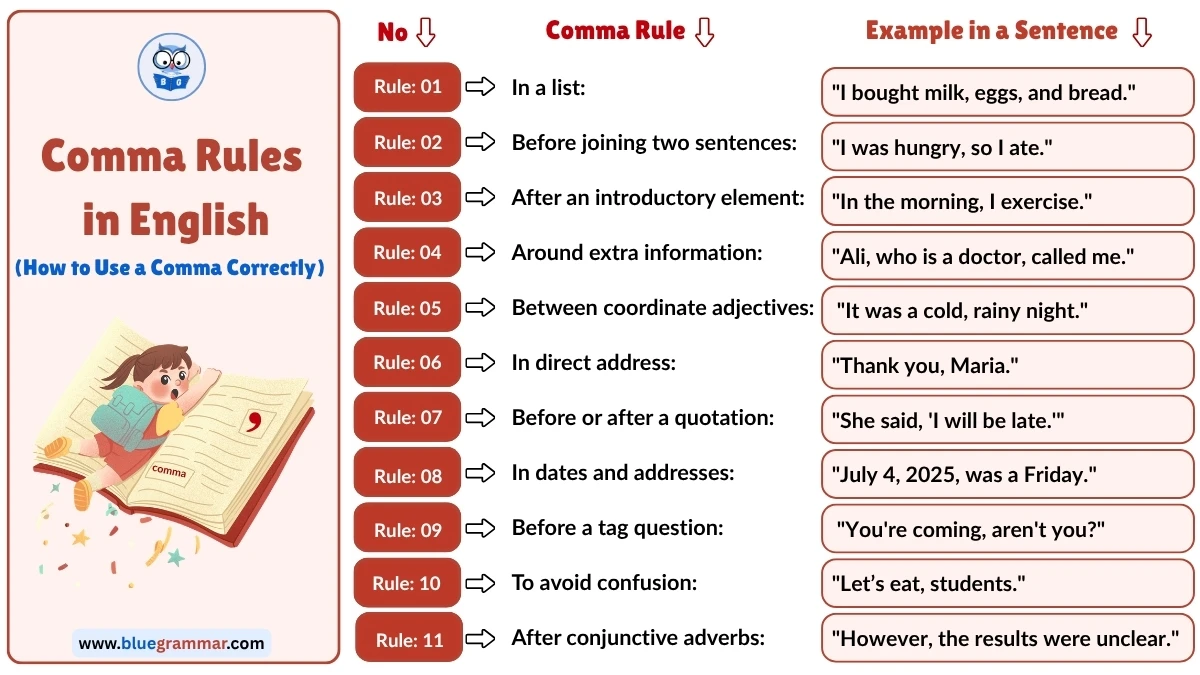
Of all the punctuation marks in English, the comma is the one that causes the most confusion — for native speakers and ESL learners alike. It is small, easy to overlook, and easy to overuse. Yet the comma is one of the most powerful tools in written English. A single comma in the wrong place can completely change the meaning of a sentence, while a missing comma can make a sentence difficult or even impossible to understand.
This guide covers all the major comma rules in clear, simple English. Each rule is explained with examples so that you can see exactly how and why the comma is used. Whether you are a high school student, a college learner, or someone who simply wants to write more clearly, this article will give you the confidence to use commas correctly every time.
What Is a Comma?
A comma ( , ) is a punctuation mark that signals a pause within a sentence. Unlike a period, which ends a sentence completely, a comma separates parts of a sentence while keeping them connected. Commas help readers understand which ideas belong together and where one part of a sentence ends and another begins. Without commas, even simple sentences can become confusing or misleading.
Commas in Lists (Series of Items)
One of the most common uses of commas is to separate items in a list. This helps the reader clearly identify each item without confusion.
Rule 1: Use a Comma to Separate Items in a List
When you list three or more items in a sentence, use a comma to separate each item. This makes the list easy to read and prevents the items from running together.
- She bought apples, oranges, and bananas.
- The report was clear, detailed, and well-organized.
- He packed his clothes, his laptop, his charger, and his passport.
The comma that comes just before the word “and” or “or” at the end of a list is called the Oxford comma (also called the serial comma). Some style guides say the Oxford comma is optional, but using it is strongly recommended because it prevents ambiguity. Consider this example:
- Without Oxford comma: I’d like to thank my parents, the principal and the coach.
- With Oxford comma: I’d like to thank my parents, the principal, and the coach.
Without the Oxford comma, the sentence could be misread as saying that “the principal and the coach” are the writer’s parents. The Oxford comma removes that confusion entirely. For ESL learners, the safest rule is to always use the Oxford comma in your writing.
Comma Before Coordinating Conjunctions
A coordinating conjunction is a short word that joins two independent clauses (two complete sentences). The seven coordinating conjunctions in English are: for, and, nor, but, or, yet, so. A useful way to remember them is the acronym FANBOYS.
Rule 2: Use a Comma Before a Coordinating Conjunction
When you join two independent clauses with one of these words, place a comma before the conjunction.
- I wanted to go to the party, but I had too much work to finish.
- She studied hard for the exam, so she felt confident on the day.
- We can leave now, or we can wait until the rain stops.
- He did not call, nor did he send a message.
Important note: Do not use a comma if the conjunction is not joining two full, independent sentences. If only one side is a complete thought, skip the comma.
- ✔ Correct: She is intelligent and hardworking. (no comma — “hardworking” is not an independent clause)
- ✔ Correct: She is intelligent, and she works hard. (comma — both sides are complete sentences)
Commas After Introductory Elements
Introductory words, phrases, or clauses appear at the beginning of a sentence and provide background information.
Rule 3: Use a Comma After an Introductory Word, Phrase, or Clause
When a sentence begins with an introductory element — a word, phrase, or clause that comes before the main subject — place a comma after it. This introductory element sets the context for the main idea that follows.
After a single introductory word:
- However, the results were not what we expected.
- Unfortunately, the flight was cancelled.
- Yes, I would love to attend the conference.
- No, that is not what I meant.
After an introductory phrase:
- In the morning, I like to read for thirty minutes.
- After a long day at work, she needed to rest.
- During the meeting, the manager explained the new policy.
After an introductory clause:
- If it rains tomorrow, we will reschedule the event.
- Because she arrived late, she missed the introduction.
- When the clock struck midnight, the celebration began.
The comma after an introductory element is important because it signals to the reader: “the main point of this sentence is coming now.” Without it, the sentence can feel rushed or unclear.
Commas with Nonessential Information
Sometimes a sentence contains extra information that adds detail but is not essential to the core meaning. This information is called a non-essential clause or a non-restrictive clause.
Rule 4: Use Commas to Set Off Non-Essential Information
Sometimes a sentence includes extra information that is not necessary for its main meaning. You set it off with commas on both sides — one before it begins and one after it ends. If you remove the information and the sentence still makes complete sense, the information is non-essential and needs commas.
- My teacher, who has lived in London for ten years, speaks excellent English. (The identity of the teacher is already clear; “who has lived in London for ten years” is extra detail.)
- The Eiffel Tower, which was built in 1889, is one of the most visited landmarks in the world.
- My dog, a golden retriever, loves to play in the park.
- Professor Adams, the head of the department, will deliver the opening lecture.
Compare these with essential clauses, which identify or define the subject. Essential clauses do not take commas:
- Non-essential (commas): My brother, who lives in Canada, is visiting next week. (I only have one brother.)
- Essential (no commas): The student who sits in the front row always asks good questions. (There are many students; this clause tells us which one.)
This is one of the most important comma rules for ESL learners. Misusing it — either adding commas where they do not belong or forgetting them where they are needed — is among the most common errors in written English.
Commas with Coordinate Adjectives
When two or more adjectives describe the same noun equally, they are called coordinate adjectives.
Rule 5: Use a Comma to Separate Coordinate Adjectives
When two or more adjectives independently and equally describe the same noun, separate them with a comma. These are called coordinate adjectives.
- It was a long, exhausting journey.
- She is a kind, patient, and dedicated teacher.
- He wore a clean, pressed shirt to the interview.
How do you know if adjectives are coordinate? Use the “and test.” Insert the word “and” between the adjectives. If the sentence still sounds natural, use a comma. If it sounds awkward, do not use a comma.
- “It was a long and exhausting journey.” — sounds natural → use a comma
- “She has a large and red bag.” — sounds awkward → no comma needed (write: “She has a large red bag.”)
The second test is the order test: try reversing the adjectives. If the sentence still makes sense, use a comma. If the reversed order sounds wrong, no comma is needed.
Commas in Direct Speech
Commas are used to separate quoted speech from the rest of the sentence.
Rule 6: Use Commas with Direct Address
When you address someone directly by name or title in a sentence, separate their name from the rest of the sentence with a comma. This is called a vocative comma, and it is more important than many learners realize. Without it, a sentence can take on a very different — sometimes alarming — meaning.
- Sarah, please close the door.
- I appreciate your help, Professor.
- Can you tell me, James, what you think about this?
The classic example that shows why this comma matters:
- Without comma: “Let’s eat Grandma!” (This sounds like you want to eat your grandmother.)
- With comma: “Let’s eat, Grandma!” (You are calling your grandmother to dinner.)
The comma is a small mark, but here it is the difference between an invitation and a threat. Always use it when directly addressing someone by name or title.
Rule 7: Use a Comma to Separate Direct Quotations
A comma is used to separate direct speech from the rest of the sentence. However, the comma is not always placed both before and after the quotation—it depends on the sentence structure. Use a comma before a quotation when it follows a reporting verb (like said, told, asked). Use commas inside the sentence when the quotation is split into two parts.
- She said, “We need to leave now.”
- “The exam,” he announced, “will take place on Friday.”
- “I am not ready,” she admitted quietly.
- The teacher told the class, “You have done excellent work this semester.”
Note that the comma is placed inside the quotation marks in American English. When the quotation ends with a question mark or exclamation mark, you do not add an extra comma:
- “Are you sure?” he asked. (no comma after the question mark)
- “Watch out!” she screamed. (no comma after the exclamation mark)
Commas with Dates, Addresses, and Numbers
Commas are used in specific formats such as dates, addresses, and large numbers.
Rule 8: Use Commas in Dates, Addresses, and Numbers
Dates: In American English, when writing a full date (month, day, and year), place a comma after the day and after the year if the sentence continues.
- The agreement was signed on June 15, 2023, in Washington.
- She was born on March 3, 2001.
If you write only the month and year, no comma is needed:
- The report was published in April 2024.
Addresses: When writing an address within a sentence, use commas to separate the city from the state or country, and after the state or country if the sentence continues.
- She moved to Austin, Texas, after finishing her degree.
- The conference will be held in Paris, France, next October.
Numbers: Use a comma to separate every three digits in large numbers to make them easier to read.
- The population of the city is 3,450,000.
- The project had a budget of $1,200,000.
- There were 8,500 attendees at the event.
Note: Do not use commas in years, page numbers, or street addresses (e.g., page 1200, the year 2025, 4500 Main Street).
Commas in Tag Questions
A tag question is a short question added at the end of a statement. It usually asks the listener to confirm what has been said.
Rule 9: Use a Comma with Tag Questions
Always place a comma before a tag question.
- It is a beautiful day, isn’t it?
- You have submitted the assignment, haven’t you?
- She speaks three languages, doesn’t she?
- We need to leave soon, don’t we?
Comma After Conjunctive Adverbs
Words like however, therefore, moreover, and nevertheless connect ideas between sentences.
Rule 10: Use a Comma After Conjunctive Adverbs
When conjunctive adverbs begin a clause, they are usually followed by a comma.
- However, the results were not accurate.
- Therefore, we decided to repeat the experiment.
Use Commas to Prevent Confusion
In some cases, commas are essential because they change the meaning of a sentence. A missing comma can make a sentence unclear or even give it a completely different meaning.
Rule 11: Use Commas to Avoid Confusion in a Sentence
Commas help separate ideas clearly so that the reader understands the intended message without ambiguity.
- Let’s eat, students.
- Let’s eat students.
The first sentence invites students to eat, while the second suggests something completely different.
Common Comma Mistakes to Avoid
Understanding what NOT to do is just as important as knowing the rules. Here are the three most common comma errors in English.
1. The Comma Splice
A comma splice happens when two complete, independent sentences are joined with only a comma. This is incorrect because a comma alone is not strong enough to join two independent clauses.
- ❌ Incorrect: I was tired, I went to bed early.
- ✔ Correct: I was tired, so I went to bed early.
- ✔ Correct: I was tired. I went to bed early.
- ✔ Correct: I was tired; I went to bed early.
2. The Missing Comma After an Introductory Element
Many learners forget to add a comma after a word, phrase, or clause that introduces the main sentence. This makes the sentence harder to read.
- ❌ Incorrect: After the presentation he answered several questions.
- ✔ Correct: After the presentation, he answered several questions.
3. The Unnecessary Comma Between Subject and Verb
Never place a comma between the subject of a sentence and its verb. This is a very common error and it interrupts the natural flow of the sentence.
- ❌ Incorrect: The student who sits in the front row, always asks good questions.
- ✔ Correct: The student who sits in the front row always asks good questions.
Quick Reference: 11 Comma Rules at a Glance
- In a list: “I bought milk, eggs, and bread.”
- Before joining two sentences: “I was hungry, so I ate.”
- After an introductory element: “In the morning, I exercise.”
- Around extra information: “Ali, who is a doctor, called me.”
- Between coordinate adjectives: “It was a cold, rainy night.”
- In direct address: “Thank you, Maria.”
- Before or after a quotation: “She said, ‘I will be late.’”
- In dates and addresses: “July 4, 2025, was a Friday.”
- Before a tag question: “You’re coming, aren’t you?”
- After conjunctive adverbs: “However, the results were unclear.”
- To avoid confusion: “Let’s eat, students.”
Conclusion
The comma is one of the most versatile punctuation marks in the English language. Mastering it takes practice, but the rules are logical once you understand the ideas behind them. Every comma rule exists for the same fundamental reason: to make writing clearer, more precise, and easier to read.