
Colon vs. Semicolon
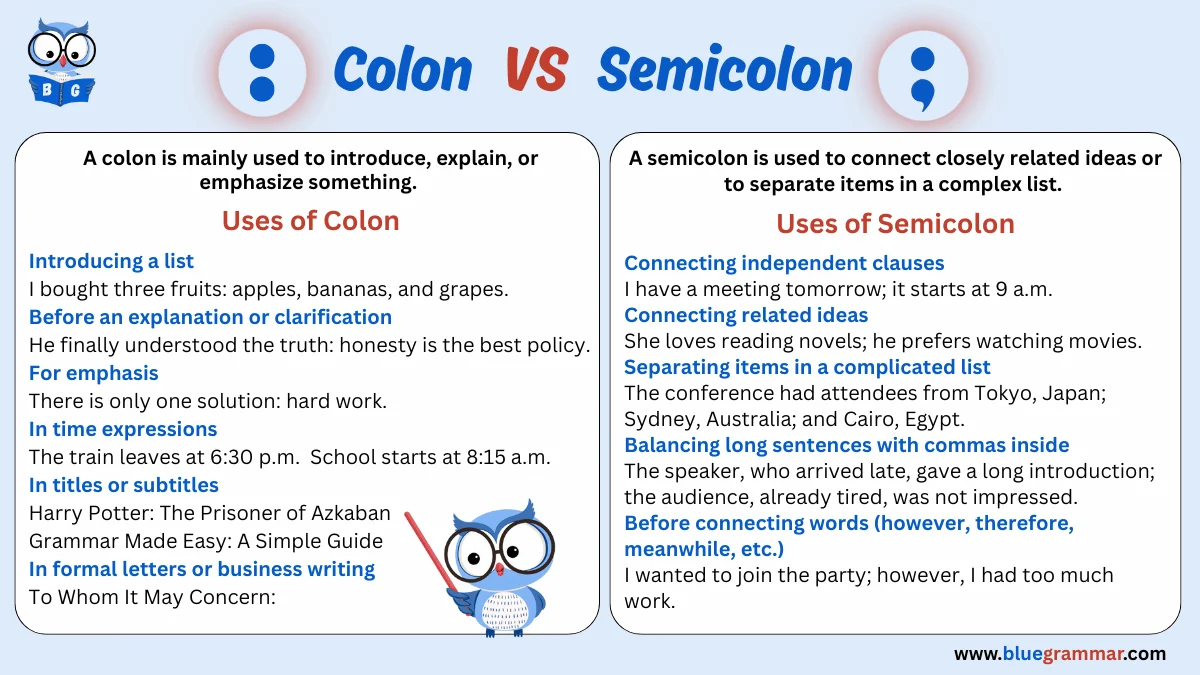
The colon ( : ) and semicolon ( ; ) are two important punctuation marks in English grammar. Although they look similar, they serve different purposes in a sentence. Many learners struggle to use them correctly, which often leads to confusion and punctuation errors. Understanding how and when to use each mark can greatly improve clarity and writing confidence.
Why Are Colons and Semicolons Confusing?
Colons and semicolons are confusing because both are used within sentences rather than at the end. Unlike full stops or commas, their roles are less obvious, especially to beginners. Writers often hesitate when deciding which mark best fits a sentence.
Another reason for confusion is that both punctuation marks connect ideas. A colon introduces information, while a semicolon links related ideas. When the relationship between ideas is not clearly understood, writers tend to use one in place of the other.
Their similar appearance also causes mistakes. Since the semicolon looks like a combination of a comma and a period, many learners use it incorrectly as a strong comma. Similarly, colons are often misused to join two sentences, which is not always correct.
Colon vs. Semicolon Examples
Colon vs. Semicolon: Key Differences
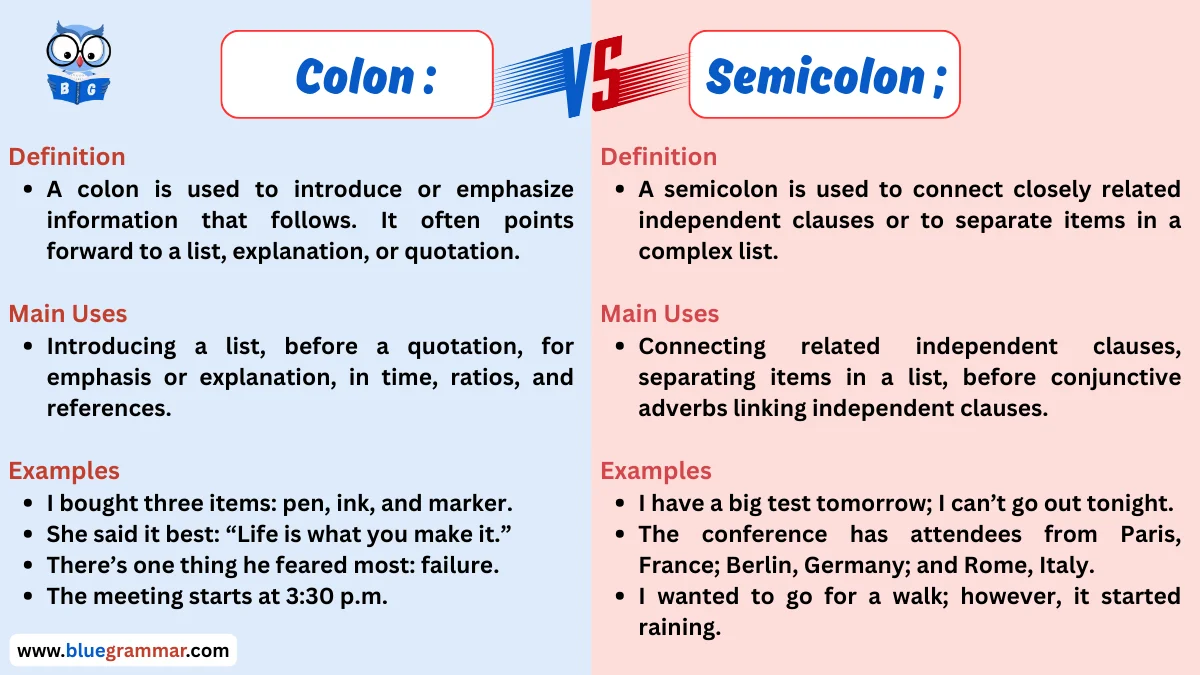
The main difference between a colon and a semicolon lies in their function. A colon is used to introduce something, such as a list, explanation, or example. It tells the reader that additional information is coming next.
A semicolon, on the other hand, is used to join two closely related independent clauses. Each part of the sentence connected by a semicolon can stand alone as a complete sentence, but the semicolon shows that the ideas are strongly connected.
In short: A colon points forward, while a semicolon connects side-by-side ideas.
Common Mistakes with Colon and Semicolon
One common mistake is using a colon to connect two complete sentences without explanation.
- ❌ Incorrect: I was tired: I went to bed early.
- ✔ Correct: I was tired; I went to bed early.
Another frequent error is placing a semicolon before a conjunction like and or but.
- ❌ Incorrect: She likes tea; and she drinks it daily.
- ✔ Correct: She likes tea; she drinks it daily.
Learners also incorrectly place colons after verbs or prepositions when introducing simple lists.
- ❌ Incorrect: My hobbies are: reading and writing.
- ✔ Correct: My hobbies are reading and writing.
Colon (:) Examples
Use a colon when introducing an emphasis, a list, or a direct statement that explains the preceding clause:
- He had one goal: success.
- Please bring the following items: a pen, a notebook, and an ID card.
- She remembered one rule: always be honest.
Semicolon (;) Examples
Use a semicolon to link independent clauses or clauses joined by conjunctive adverbs:
- I wanted to go outside; it started raining.
- She loves reading; her brother prefers sports.
- The exam was difficult; however, most students passed.